The 2026 Formula 1 season marks the biggest change to the sport's hybrid systems since their introduction in 2014. The power unit now delivers roughly 50% of its output from the internal combustion engine and 50% from a 350kW electric motor.
That electric motor is the MGU-K (Motor Generator Unit - Kinetic), which has nearly tripled in power from the previous 120kW limit. The battery that powers this system is no longer a background component. It has become the central strategic weapon in a Grand Prix.
What is the Energy Recovery System (ERS)?
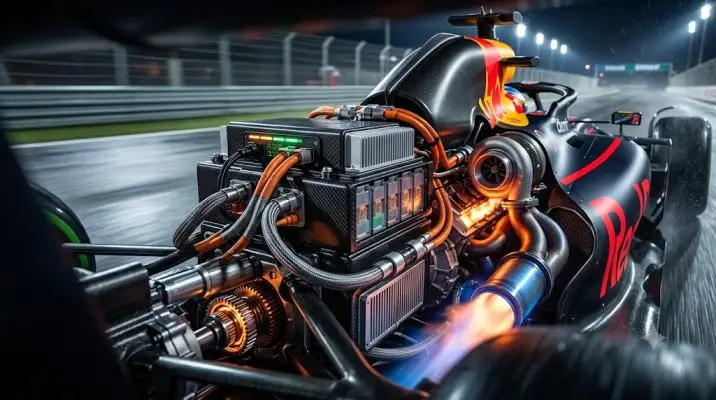
An F1 car's ERS is a hybrid system that captures energy normally lost during braking and converts it into electrical power for instant acceleration. The 2026 system has three core components:
Read Also: How Cadillac F1 Plans to Accelerate Its In-House General Motors Power Unit?
-
MGU-K (Motor Generator Unit - Kinetic): Mounted to the engine crankshaft. It acts as a motor to drive the rear wheels and as a generator to capture energy during braking .
-
Energy Store (ES): The lithium-ion battery pack that holds the recovered electricity.
-
Control Electronics: The "brain" that manages how much power is harvested and deployed, and when.
How Does Energy Harvesting Work?
The MGU-K's job is to recover kinetic energy. When a driver brakes, the MGU-K acts as a generator attached to the rear axle. It resists the rotation of the wheels, slowing the car down while converting that motion into electricity.
This is effectively regenerative braking, like in a road-going electric car. The peak power of this regeneration is capped at 350kW . This is a major step up from the 250kW limit in the previous generation.
The Challenge: Where Does the Energy Come From?
With the MGU-H (which recovered energy from exhaust heat) removed for 2026, braking is now the sole source of electrical energy for the battery . This creates a physical limitation.
To generate the full 350kW of electrical power, the car needs a significant braking event . On a track with long straights and heavy braking zones, this is easy. On a flowing circuit with few heavy stops, the car may never fully recharge its battery .
Super-Clipping: Harvesting at Full Throttle
To overcome this, a new mode called "super-clipping" has been introduced . Traditionally, "clipping" was the moment on a straight where the battery ran out of power, and the car lost electrical assistance.
You Must Also Like: Vasseur Praises Hamilton and Leclerc for Professional Ferrari Intra-Team Battle in China
Super-clipping turns this concept on its head. Instead of waiting for the driver to brake, the MGU-K begins harvesting energy while the car is still at full throttle near the end of a straight . This gives a slight deceleration effect but allows the battery to recharge earlier.
Under the original 2026 rules, this was limited to 250kW. The FIA has since increased the peak super-clip power to 350kW . This charges the battery faster, reducing the odd-looking "lift and coast" behavior that drivers complained about.
How is Energy Deployed?
Once harvested, the battery stores up to 4MJ of usable energy at any one time. This is a strict limit on how much the state of charge can change per lap. It forces teams to think of the battery like a flow system: energy is constantly cycled through it .
Drivers deploy this energy in two ways:
-
Standard Deployment: The Control Electronics automatically deploy electrical power to fill in the gaps of the internal combustion engine's power curve, optimizing acceleration out of corners.
-
Manual Override (Boost): Drivers can press a button to access the full 350kW for overtaking. In 2026, this is restricted to +150kW in race conditions to prevent dangerous speed differentials between cars.
The 2026 Rule Adjustments
The 2026 season started with drivers and engineers complaining about the way the cars handled energy. The FIA made a series of adjustments starting in Miami 2026:
| Change | Impact |
|---|---|
| Peak Super-Clip Power | Increased to 350kW from 250kW. Reduces the time needed to recharge . |
| Qualifying Recharge Limit | Reduced to 7MJ per lap from 8MJ. Limits "over-charging" and unnatural driving . |
| Boost Power Cap (Race) | Boost is capped at +150kW. Limits sudden speed differentials between cars on straights . |
What the Drivers Say?
Lewis Hamilton has described the new energy management systems as difficult to understand, even for the drivers themselves . He explained the fundamental paradox: "If you take more risk and go faster through a corner, you end up penalized afterwards because you haven't managed to recharge enough".
This is the central tension of the 2026 regulations: the driver who pushes the hardest through a fast corner may find themselves without the battery power to defend or attack on the following straight. Energy management has become as important as raw speed.