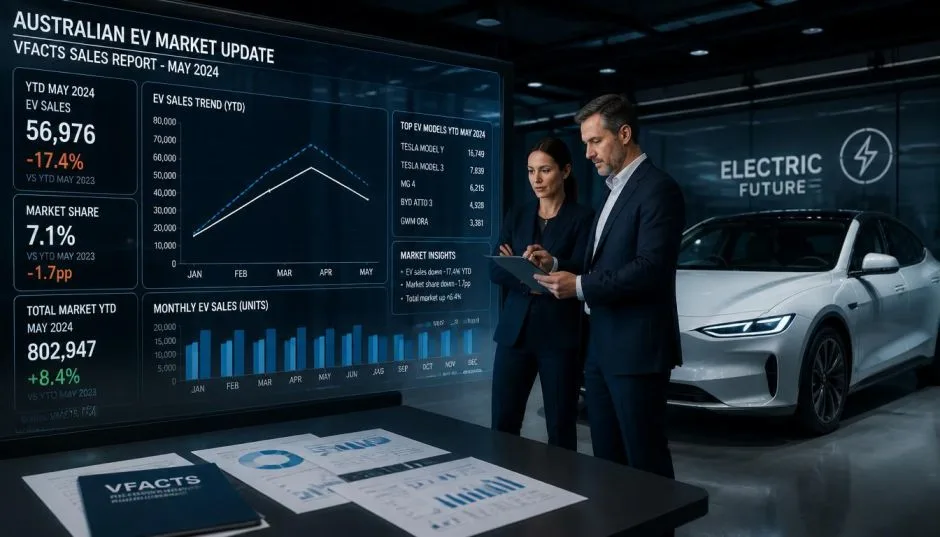
I have been watching the VFACTS data closely this year. I remember May 2026. The headlines were everywhere. Tesla Model Y became the best-selling car in Australia for the first time ever. EV sales hit a record 19.9 per cent market share. Everyone was talking about the EV revolution.
Then I started hearing a different story. Car dealers were saying the surge was temporary. Some brands predicted interest would drop back to pre-crisis levels. And honestly? I think they have a point.
Let me explain why EV sales are dropping VFACTS according to the latest insights. It is not what you think.
The Numbers That Confuse Everyone
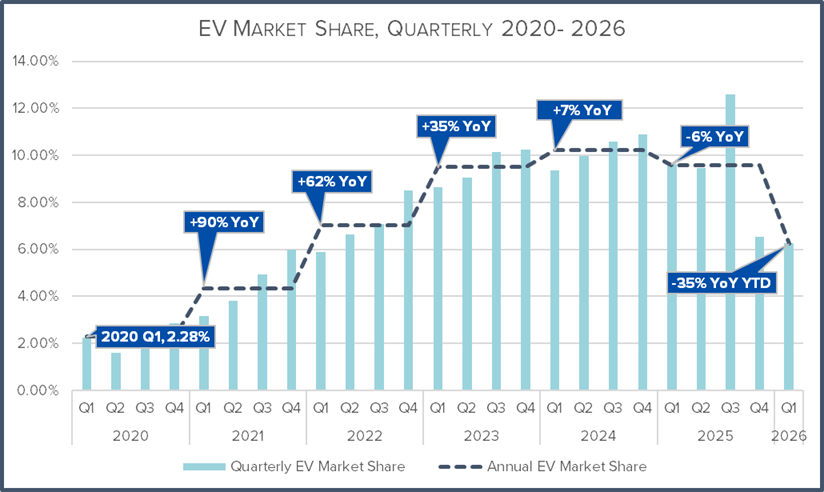
The VFACTS May 2026 data shows something fascinating. Australians bought 103,855 battery electric vehicles in the first six months of 2026. That is more than the whole of 2025. EVs now make up 23.4 per cent of new car sales.
Related Article: VFACTS 2026: EV Market Share Hits Record 16.4% in Australia As BYD Surges
Plug-in hybrids are also booming. 54,121 sold in the first half of 2026 compared with 53,249 throughout all of 2025.
June 2026 was even crazier. The market hit an all-time monthly record of 140,058 deliveries. Battery EVs accounted for 23.3 per cent of total sales.
So why are we talking about a drop?
Because the surge might not be sustainable.
The Fuel Crisis Factor
The spike in EV sales is directly tied to something specific. The Middle East conflict. Fuel prices went through the roof. People panicked .
Julie Delvecchio from the Electric Vehicle Council put it plainly. "It's clear that the fuel crisis has reminded all of us how reliant we really are on overseas fuel" .
George Whitcombe, an EV analyst at Benchmark Mineral Intelligence, said it is rare for an automotive market to experience such a significant increase in EV sales so quickly .
The problem? Panic buying is not a long-term strategy.
What Dealers Are Saying?
I spoke with industry insiders. They are worried.
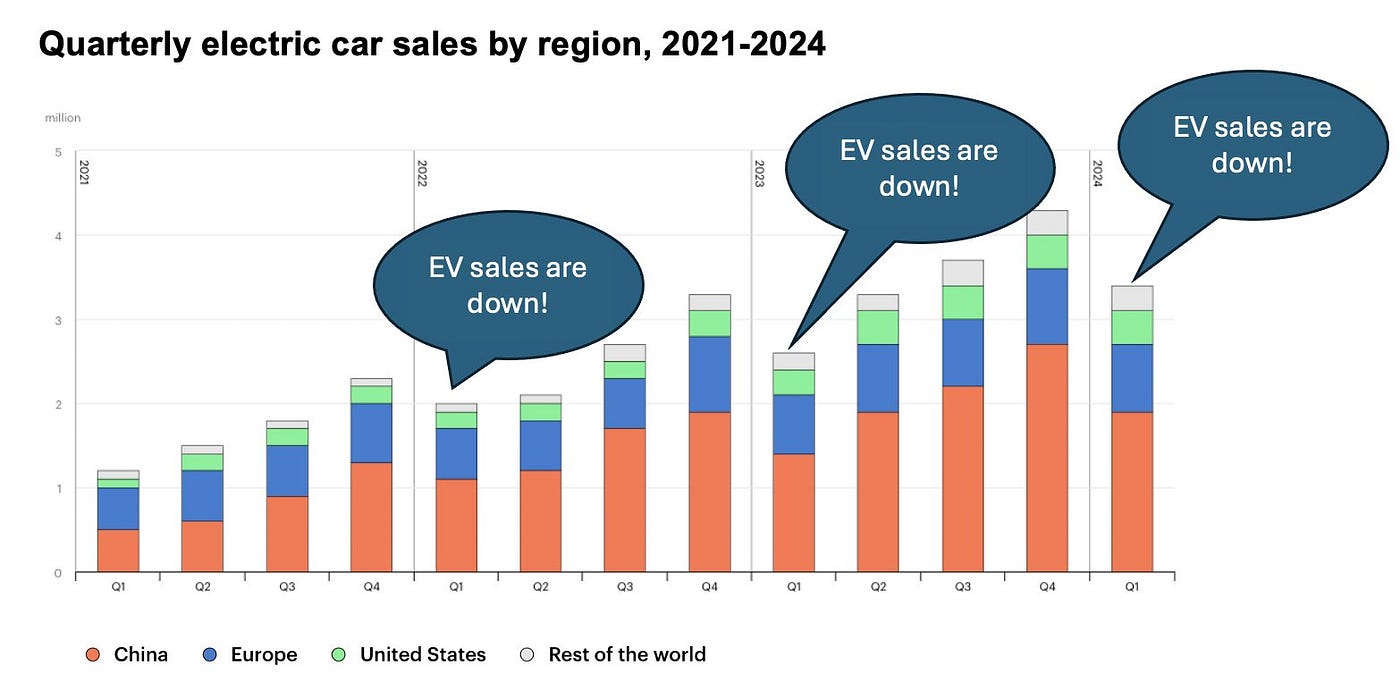
Mark Beitz, managing director of Bartons Motor Group, gave a brutal reality check. He said the June VFACTS numbers are inflated by backlog deliveries. Many vehicles were sold months ago and only registered in June .
You Must Also Like: VFACTS April 2026: Segment Winners Australia Trends
"People's rush to buy EVs lasted about a month," he said . "The order momentum has weakened since May. The new orders we are getting now are nothing like what we saw in April" .
Mazda Australia boss Vinesh Bhindi agrees. He believes EV interest will return to pre-crisis levels soon. Around 10 to 15 per cent of the market, not 20 per cent .
"I don't think what VFACTS is reflecting is reflective of the industry," Bhindi said . Harsh words. But he might be right.
What to Expect Next?
The EV sales Australia June 2026 numbers were record-breaking. But the industry expects deliveries to cool as the fuel price anxiety normalises .
Tony Weber from the FCAI noted that 80 per cent of EV sales occurred in just two market segments: small SUV and medium SUV . That is a concentration problem.
"The ongoing transition will depend on vehicles remaining affordable and the continued expansion of model choice into new market segments," Weber said .
In other words, EVs need to appeal to more than just SUV buyers.
The Charging Infrastructure Problem
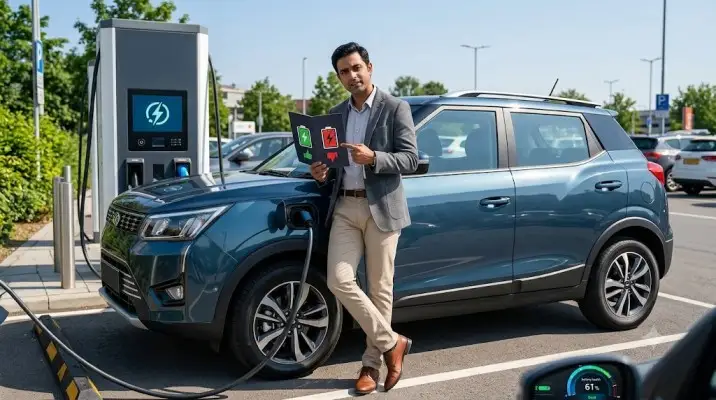
Here is something nobody is talking about enough. Charging infrastructure.
Weber has been clear. "As the number of EVs on the road continues to grow, charging infrastructure must become more of a priority" .
"Charging infrastructure rollout must accelerate if Australia is to maintain consumer confidence and support continued uptake" .
I have spoken to EV owners who love their cars. But they also complain about finding chargers on road trips. The infrastructure is not keeping up with the sales surge. That is a problem.
The Chinese Invasion
One thing is undeniable. Chinese brands are reshaping the market.
In May 2026, China was the single largest source of new vehicles in Australia. 30,548 vehicles. Up 77.2 per cent year-on-year .
BYD was Australia's second-best-selling brand for the second month in a row. 8,211 deliveries. Up 154.6 per cent . BYD's Atto 1 became Australia's best-selling light car at just $23,990 .
Jaecoo J5 entered the top 10 best-sellers in May. An electric SUV priced at $36,990 drive-away . Orders took off after the Middle East conflict started.
The brands are competing hard. That is good for buyers. But traditional brands like Mazda are getting squeezed. Mazda dropped to seventh place in May. Down 27.4 per cent . No EV available for immediate delivery is becoming a measurable drag.
What This Means for You?
If you are thinking about buying an EV, here is my honest advice.
Wait if you can. The surge is driven by panic. Prices might stabilise when demand cools.
Check the infrastructure. Can you charge at home? Do you have regular long trips? These questions matter.
Look at the total cost. EVs are cheaper to run. But upfront costs can be higher. Do the math.
Consider plug-in hybrids. They offer flexibility. 8.7 per cent of new vehicles in May were PHEVs. Up 202.3 per cent . They are a solid middle ground.
The Final Thoughts
Are EV sales dropping VFACTS? The data says no. But the industry says wait. The surge is real. It is driven by a fuel crisis. But it is probably not sustainable at current levels. VFACTS May 2026 showed record EV sales. But the industry expects a return to normal.
I have been following this closely. The shift is real. But it is a marathon, not a sprint. The infrastructure needs to catch up. The prices need to come down. And the models need to expand beyond SUVs.
I will be watching the next VFACTS numbers closely. And I suggest you do too.