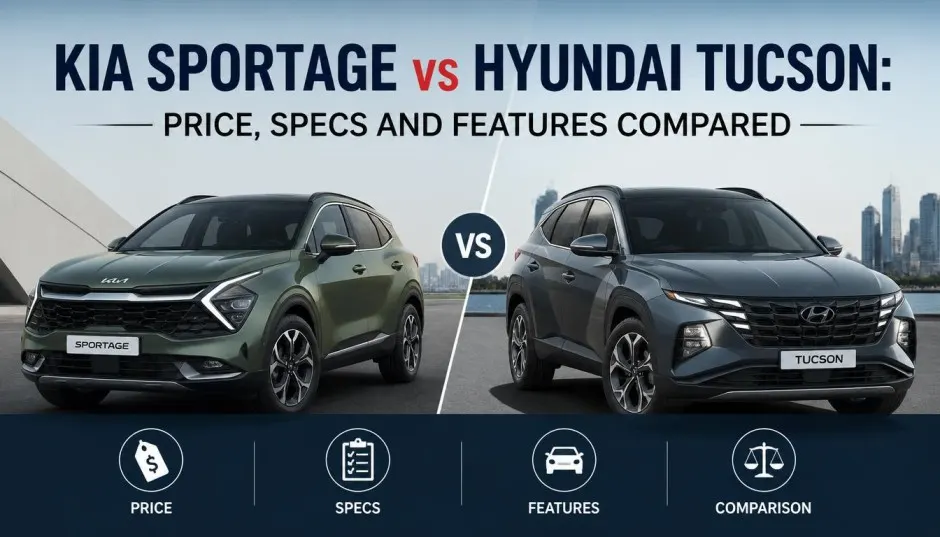
I spent last weekend driving both SUVs back to back. Same roads. Same weather. Same driving style.
The Kia Sportage vs Hyundai Tucson debate has been going on for years. And honestly, it is easy to see why . These two are sister vehicles. Same platform. Similar engines. Nearly identical dimensions.
But they are not the same car.
I wanted to know which one actually feels better to live with. Which one gives you more for your money. Which one you should pick based on how you actually drive.
Here is what I found.
Price Comparison
Let us start with the numbers. Because price matters.
The Kia Sportage vs Hyundai Tucson price difference is not huge. But it is there.
Read Also: Mercedes-Benz CLA EV India Launch Date Confirmed: 792km Range & 20-Min Fast Charging!
In India, the Hyundai Tucson starts at ₹22.64 lakh (ex-showroom). The top-spec diesel 4WD variant goes up to ₹35.46 lakh . The Kia Sportage, on the other hand, starts at ₹25 lakh . That is a ₹2.36 lakh gap at the entry level.
In the US market, the Tucson starts around $29,450 for the base SE FWD and goes up to about $39,425 for the Limited FWD . The Sportage starts lower, at roughly $28,790 for the base LX FWD, and tops out around $38,190 for the SX-Prestige FWD .
In Australia, the base Tucson is priced around $42,065 driveaway, while the Sportage S is $42,147 . Practically identical.
Warranty is another difference. In Australia, the Sportage comes with a 7-year warranty compared to the Tucson's 5-year warranty . That is two extra years of peace of mind.
Fuel Economy: Which One Saves More at the Pump?
The Hyundai Tucson vs kia Sportage fuel economy comparison is interesting.
Both base models with the 2.0-litre petrol engine consume 8.1L/100km combined . Identical.
The difference shows up in the hybrids.
The Kia Sportage SX Hybrid is rated at 4.9L/100km combined. The Tucson Elite Hybrid comes in at 5.2L/100km . That 0.3L difference might not sound like much. Over a year of driving, it adds up.
In the US, the Tucson hybrid gets 38 mpg city and highway . The Sportage hybrid S AWD gets 35 city and 36 highway . Both are impressive for SUVs this size.
The hybrid range is also strong. With a 52-litre fuel tank, the Sportage hybrid can theoretically cover over 1,000 km on a full tank . The Tucson offers similar range.
If fuel economy is your priority, the hybrid versions are clearly the better choice. The extra upfront cost pays off over time.
Design and Styling
This is where the two SUVs really separate.
The Hyundai Tucson is bold. Some might say aggressive. Hyundai calls it "Parametric Dynamics" . Sharp creases. Geometric edges. LED lights built into the grille. A light bar across the rear.
You Must Also Like: Luxury Cars vs Sports Cars: Which Offers Better Value
I saw one parked on the street last week. It stood out. No question about it.
But some people find it too busy. Too much going on.
The Kia Sportage is more restrained. Still modern. Still eye-catching. But less in-your-face . The boomerang-style daytime running lights are a standout. The design flows from front to back without harsh angles.
Which looks better?
That is personal. If you want to turn heads, the Tucson is hard to miss. If you prefer something more refined and premium, the Sportage wins.
Interior and Space
Both SUVs seat five comfortably.
The Sportage is slightly bigger overall . You notice it in the cabin. Rear seat passengers get more room. There are USB-C ports built into the seatbacks. A nice touch for keeping devices charged.
Cargo space also goes to the Sportage. The SX Hybrid offers 587 litres of boot space. The Tucson Elite Hybrid gives you 558 litres . Not a massive difference. But if you carry sports gear or strollers regularly, that extra 29 litres matters.
In the US, the Sportage offers 39.6 cubic feet behind the second row. The Tucson has 38.7 cubic feet . Same story. The Sportage has a slight edge.
Interior quality is close. Both use similar materials. Both feel well put together.
The Tucson has a cleaner centre layout. The Sportage has smarter storage solutions .
Performance and Driving
Here is where the driving experience matters more than the spec sheet.
Both use the same 1.6-litre turbo hybrid powertrain in their hybrid versions. 169kW and 350Nm of torque. Six-speed automatic transmission. On paper, they are identical. But they feel different on the road.
The Sportage has been tuned for Australian conditions specifically. The ride is more settled over rough roads and speed bumps. It feels more stable when cornering at speed.
The Tucson is smooth and predictable. Great for city driving. Comfortable on highways. But it does not feel quite as dialled in on uneven surfaces. Steering is light and direct in both. Parking is easy. Low-speed manoeuvres feel effortless.
If you do a mix of freeway, hills, and suburban trips, the Sportage has a slight edge. If you mostly drive in the city, the Tucson is just fine.
The non-hybrid versions tell a different story. The 2.0-litre petrol in both is adequate but not exciting. The 2.5-litre in the US Sportage has been described as slow and working hard at highway speeds .
Technology and Features
Both SUVs are well-equipped.
The Tucson Elite Hybrid gives you a 12.3-inch touchscreen. Wireless Apple CarPlay and Android Auto. Digital driver display. Wireless charging. Dual-zone climate control .
The Sportage SX Hybrid has a similar setup. Same 12.3-inch infotainment screen. Same wireless smartphone integration. Same six-speaker audio system .
One standout in the Sportage is the dual-function touch bar. It swaps between climate and media controls at the press of a button . Took me a few minutes to get used to. But once I did, I liked it.
Another small touch in the Sportage. Rear USB-C ports integrated into the seatbacks. Smart for road trips with kids .
In higher trims, both offer bigger screens and more premium features. The Tucson gets a fully digital instrument cluster. The Sportage has a smaller driver display in the SX Hybrid .
The Tucson has a power tailgate on the Elite Hybrid. The Sportage does not . That might matter to you.
Safety
Both SUVs are safe. Five-star ANCAP ratings across the board .
Both come with standard safety features. Autonomous emergency braking. Lane keeping assist. Blind spot monitoring. Adaptive cruise control.
The Tucson's adaptive cruise control works smoothly. The Sportage's is similar. Both have stop-and-go functionality for traffic.
In the US, higher trims get more advanced safety tech. Adaptive cruise control is reserved for higher trims on the Sportage .
Which One Should You Buy?
Here is my honest take.
Choose the Hyundai Tucson if:
-
You want a bold, distinctive design that stands out
-
You prefer a cleaner, more minimalist interior layout
-
You do not need the extra boot space
-
You like the power tailgate feature
-
You want a digital instrument cluster in the mid-tier hybrid
Choose the Kia Sportage if:
-
You value slightly better fuel economy (4.9 vs 5.2L/100km)
-
You need more rear passenger space and boot space
-
You want a longer warranty (7 years vs 5 in some markets)
-
You drive on rough roads regularly (better suspension tuning)
-
You appreciate smart storage solutions and seatback USB ports
Both are excellent SUVs. You cannot go wrong with either.
But if I had to pick one, I would lean toward the Sportage. The better fuel economy, more spacious cabin, and longer warranty give it a slight edge.
The Tucson is still a great choice. That bold design appeals to many. And the power tailgate is genuinely useful. Test drive both. See which one feels right to you.
Because at the end of the day, the best car is the one you actually enjoy driving.