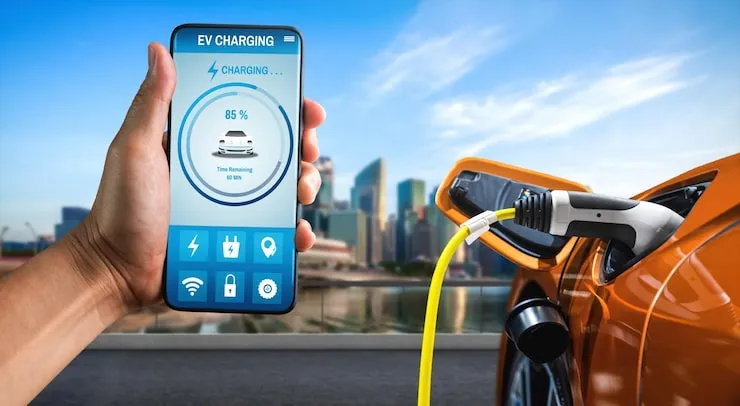
Fast EV charging can cost up to three times more than charging at home with public DC fast charging averaging $0.47 per kilowatt-hour compared to $0.18/kWh for home charging. While pulling up to a public fast charger and adding hundreds of miles in minutes sounds incredibly convenient the reality of the cost can be surprising. This convenience comes with a significant price premium that affects your overall cost of electric vehicle ownership.
Many new EV owners quickly learn that public charging station fees and EV charging expenses add up faster than expected. The promise of quick electric vehicle refueling is appealing, but understanding the true fast charging cost is essential for making smart decisions as an EV driver.
Fast EV Charging Sounds Convenient: What Is It Really?
Fast EV charging is convenient as it is supposed to charge your electric vehicle battery fast like charging a gas tank. This technology has a formal name of DC fast charging or Level 3 charging and can provide a charge of 80 percent in around 20-30 minutes to most modern EVs. The speed is great on the road trip or when you are in a hurry and you cannot afford to wait till you can charge the battery slowly.
The process with the help of a public charging network station should be easy. You park up connect your vehicle with a universal car charger connector and your car starts to quickly charge. You may take a coffee take a break in the toilet during this period or check messages on your phone. It is an efficient and modern experience when it comes to EV charging which is unlike several hours of waiting until a Level 2 charger finishes its work.
You may also read :- Public EV Charging Isnt as Cheap as Buyers Expect
Fast EV Charging Costs: Home vs. Public Reality Check
The True Price of Plugging In Publicly
When you charge on a public DC fast charger you are paying an expensive price of speed and location. According to recent data, the average price of the public Level 2 charge stations is 0.25 kWh, and DC fast charging is approximately 0.47 kWh. In comparison it would cost about:
- $12.96 for a full charge at home
- $18.00 for Level 2 public charging
- $33.84 for DC fast charging
The disparity is even greater as considered on an annual basis. Assuming you commute 13,489 miles/year in the US you would spend around:
- $693 with home charging
- 1,811 assuming that you used only DC fast chargers.
That is more than a thousand one hundred dollars a year in the light of fuel expenses alone. This dramatic difference is the reason why such a number of EV specialists focus on the necessity of charging at home as the way to save money in the long run.
Fast Charging Sounds Convenient: Until You See the Cost
The Convenience Premium: What Drivers Will Pay
Studies indicate that EV drivers highly appreciate convenience. A recent survey indicates that 93 percent of EV owners reported that they would be willing to pay more to charge their cars instead of having a 20-minute detour to a less expensive charger. In general, the respondents were ready to pay a 63% premium to save that time.
This convenience premium is why it is possible to pay a higher charge in charging stations where it is conveniently placed, right out of the highways or in front of restaurants or at the retail stores that one is used to. Fee Drivers are basically paying:
- Savings of time due to no need of diversion.
- Wireless charge when required, predictably and reliably.
- Such amenities as bathrooms, Wi-Fi, and food during charging.
- Less range anxiety with the knowledge of the presence of a charger when they need it.
Other Costs of Frequent Fast Charging
Battery Health and Longevity Considerations
Although the modern EVs can support the fast charging speed, the high frequency usage may affect the long-term battery health. Battery experts say the issue with regular fast charging is that, heat can be generated, and this may hasten the chemical reactions that over time will diminish the capacity of a battery.
It does not imply that you do not need to use fast charging at all, the manufacturers have provided security measures into their systems. Yet to ensure maximum battery life, most pundits advise:
- Charging on fast, not on a daily basis.
- It is advisable not to charge up to 100% on fast chargers.
- Allowing the battery to cool after rapid recharging then again.
- Taking into account the recommendations of your car manufacturer.
Studies show that battery degradation can be hastened by living in a warm climate or using DC fast charging extensively, and the battery capacity may decrease by 3 to 9 per cent. in 50,000 miles of driving. Battery replacement is a huge possible cost to the EV owner and this should be included in your overall costs.
The Time vs. Money Equation
The time investment is one of the aspects of public charging networks that people frequently disregard. Though fast charging is faster than Level 2 charging, it still takes 20-40 minutes to make a significant charge, whereas it only takes 5 minutes to fill up a gas tank.
- During this time, you might:
- Shop in local restaurants or bars.
- Browse retail stores
- Complete work/personal assignments.
- Simply wait in your vehicle
This economy of time of charging establishes its own costs and opportunities. This enforced rest period is regarded by some drivers as a good blocking period while by some it is considered an inconvenience. Retailers are now becoming aware of this trend and adding charging station facilities to make the experience a better and possibly profitable affair to their business.
The Smart EV Owner's Charging Strategy
Home charging is the cheapest solution to most EV owners. Since EV owners charge mainly at home 80 percent of them, this approach takes advantage of cheaper residential energy and the ability to repen all night long during the charging process.
The economy is strong:
- Reduced energy charges: Residential power is at an average of $0.18/kWh compared with the 0.47/kWh on the fast charges in the public.
- Saving of time: There were no visits to charging stations to charge each day.
- Battery health advantages: The slower charging is softer on your battery.
- Comfort: Get to wake up to a full tank every morning.
Although the initial expense of a Level 2 home charger (or installation) is high (usually, a Level 2 charger costs between 799 and 3,000), the payback period is significant. These expenses can be offset by a federal tax credit (30% until June 2026) and other state or utility incentives by many homeowners.
Strategic Use of Public Fast Charging
Instead of refusing to use the public fast charging, smart EV owners apply it in a strategic manner:
- Long distance travel: Fast charging suits best when one takes road trips every 200-300 miles it makes sense to stop.
- Surprising requirements: You drive further in a day than you had imagined or you forget to leave your car on charge.
- Destination charging: There are places where you charge as long as you have parked (shopping, dining, entertainment).
- Emergencies: You are in a low battery state and want to be able to get to your destination swiftly.
It is worth spending a few cents to pull up to a public DC fast charging station according to Tom Bowen of Qmerit Solutions: If you can not afford to wait till your vehicle is charged, spending a few cents more on a DC fast charging station may be worth it.
Common Myths About EV Charging Costs
Myth 1: All Charging Costs Are Basically the Same
Fact: The prices of charging differ widely depending on location, speed and network. As illustrated above, the charges in the public charging stations may be nearly 3 times more expensive than those at home. Prices vary greatly both across networks, states and individual locations with public chargers.
Myth 2: The Quick Fast-Charging Is Never Good on Your Battery
Fact: Although too much heat due to very rapid charging can hasten the process of battery degradation, new EVs have advanced thermal regulation to prevent this threat. The occasional rapid charging especially when using as per the manufacture instructions, does not pose a major threat to your battery.
Myth 3: EV Charging is too Time-Consuming to be a Realistic Solution
Fact: Charging can easily become a routine of most drivers, with the proper planning. Home charging occurs when you are sleeping, and fast road trip charging is close to natural stops to eat or have a rest.
Myth 4: Public Chargers Are not Reliable
Reality: Although early charging networks were not reliable, a lot of superiority has been achieved. In modern chargers, there is real-time monitoring and predictive maintenance with quick repair systems to maximize uptime. The studies indicate that the battery failure rate has less than 0.5 percent in newer models of EVs (since 2016).
Conclusion: Balancing Speed, Convenience, and Cost
Fast Charging Sounds Convenient- and truly it is when one requires emergency power. But the fact that it is expensive to fast charge power, implies that this convenience will incur a high price premium over home charging.
Combining mostly home charging and tactical use of public fast charging becomes the most cost-effective method of most EV owners. This balance gives low-cost daily driving benefits and still offers the ability to travel further and on short notice.
The technological advancements alone as well as the business model innovations are likely to be more forthcoming as the EV charging infrastructure matures. Which would allow lowering the cost penalty of fast charging. Meanwhile the only ones who will be able to reap the benefits of the environmental and economic benefits of owning an electric vehicle will be informed EV owners.
Frequently Asked Questions
What is the difference in the cost of fast charging versus home charging?
Public DC is estimated to be simply 2.6 times more expensive than the home average of 0.18/kWh charged, at an average cost per kilowatt-hour of around 0.47. In the case of a standard 72 kWh EV battery, this will give a full fast charge of approximately $33.84 as compared to the $12.96 at home.
Is it going to ruin my EV battery using fast chargers?
Rapid charging every now and then according to the manufacturer recommendations will not lead to much damage of your battery, but a lot of frequent use may speed up the process of degradation over time. Studies indicate that the loss of battery capacity of 3-9 percent of battery capacity within 50,000 miles is possible in heavy reliance on DC fast charging, particularly in hot climates. To address this risk, modern EVs have thermal management systems to counteract this risk during fast charging sessions.
How do EV charging costs compare to gasoline costs?
For a typical driver charging primarily at home, EV energy costs average $0.04-$0.06 per mile compared to $0.10-$0.13 per mile for a gasoline vehicle. However, relying exclusively on public fast charging narrows this gap significantly, with costs of $0.09-$0.15 per mile—similar to or occasionally higher than gasoline costs in some cases.
Is it worth installing a home charger given the upfront cost?
For most EV owners, yes. Although a Level 2 home charger installation typically costs $799-$3,000, the long-term savings from avoiding expensive public charging usually justifies this investment. Many homeowners can offset 30% of installation costs through federal tax credits available until June 2026, plus additional state and utility incentives.