Have you ever wondered how a Formula 1 car goes so incredibly fast? It’s not just a powerful engine. It’s a masterpiece of technology and design. Every single part is made to be the best. This guide will explore the amazing world of Formula 1 car engineering. We will look at how these speed machines are designed, built, and pushed to the limit.
The Heart of the Beast: Power Unit Perfection
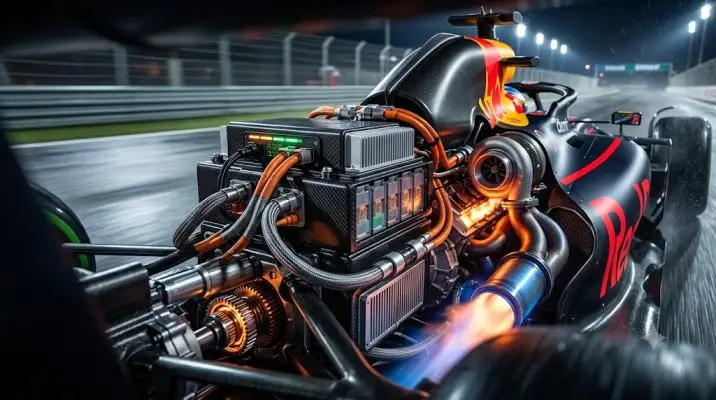
The roar of a Formula 1 car comes from its incredible power unit. This is more than just an engine. It is a hybrid system that combines old and new technology to create massive power.
A Hybrid Powerhouse: More Than Just an Engine
Modern F1 power units are engineering marvels. They have six parts: the internal combustion engine (ICE), a turbocharger, and two clever motor-generator units (MGU-K and MGU-H). The MGU-K system captures energy when the car brakes, like a super-smart battery charger. The MGU-H unit grabs heat energy from the turbo. This complex hybrid energy recovery system means the car uses every bit of energy it can find.
The Science of Staying on Track: Aerodynamics & Downforce
If power gets the car going, aerodynamics keeps it stuck to the track. Aerodynamics in F1 is the science of shaping air. The main goal is to create downforce, a powerful push that presses the car down onto the track. More downforce means more grip, allowing the car to take corners at breathtaking speeds.
Wings, Diffusers, and Ground Effect: Creating "Invisible Grip"
Look at a Formula 1 car from the side. You will see wings at the front and back. These front and rear wings are shaped to channel air. They push the air up, which pushes the car down. Under the car, the floor and diffuser are just as important. They work with the ground effect aerodynamics principle, using fast-moving, low-pressure air to suck the car to the road surface. This is how F1 teams create that magical invisible grip.
The F1 Car's Skeleton: Chassis and Materials
The chassis is the car's central structure, like its skeleton. It must be incredibly strong to protect the driver, but also extremely light to go fast. This is where advanced materials come in.
Carbon Fiber: The Wonder Material of Motorsport
Every modern Formula 1 car is built around a carbon fiber monocoque. This is a single, super-strong shell made from layers of carbon fiber cloth set in a special resin. Carbon fiber construction makes the chassis light and stiff. It can absorb huge crash impacts, keeping the driver safe. The use of such advanced composite materials is a key part of F1 chassis design.
Connecting Car to Road: Suspension and Tires
The suspension is the car’s nervous system. It connects the wheels to the chassis. It must keep the tires firmly in contact with the bumpy track surface. The tires are the only part of the car that actually touches the ground. They are critical for speed and handling.
Reading the Road: How Suspension Systems Work
F1 suspension systems are not like the ones on a regular car. They use pushrods and pullrods, springs, and dampers to react instantly to every bump and curve. F1 tire technology is also special. Pirelli makes different compounds, from soft (fast but wears out quickly) to hard (lasts longer). Managing tire wear and degradation is a huge part of race strategy. Getting the suspension setup right for each track is a constant challenge for engineers.
The Driver's Control Room: Cockpit and Controls
Inside the tiny cockpit, the driver is surrounded by technology. Every button and display gives the driver control and information. The steering wheel alone is a masterpiece of F1 car electronics.
More Than Just Steering: The F1 Steering Wheel
An F1 steering wheel is a command center. It has over 20 buttons, dials, and paddles. Drivers can change settings without taking their hands off the wheel. They adjust the energy recovery system, change brake balance, talk to their team, and more. It’s one of the most complex interfaces in all of sports.
The Engineering Race: Wind Tunnels and Simulators
Building an F1 car never stops. Teams are always trying to find more speed. They use amazing tools to test ideas before cutting any metal.
Testing in a Virtual World
CFD analysis (Computational Fluid Dynamics) uses supercomputers to simulate how air flows over a new part. Teams also use wind tunnel testing with scale models to see aerodynamic ideas in action. Drivers spend hours in F1 simulators, which are like ultra-realistic video games. These simulators help test car setups and train drivers on every track. This continuous development process is what makes F1 technical development a never-ending race.
The People Behind the Speed: Race Engineers and Pit Crews
The car is nothing without the team. The race engineer is the driver’s main contact, making strategy calls and car adjustments. The pit crew are the masters of speed off the track. A perfect pit stop strategy and execution can win or lose a race in seconds.
Teamwork at 200 MPH
During the race, the race engineer and driver are in constant communication. They discuss tire performance, when to pit, and how to manage the race. The pit crew practices their sub-2 second pit stops thousands of times. Every member has a precise job. This human element is a vital part of F1 team strategy and operations.
Innovation for the Road: How F1 Tech Helps Everyday Cars
The technology in Formula 1 doesn’t just stay on the track. It often finds its way into the cars people drive every day. This is called technology transfer from F1 to road cars.
From Track to Traffic
Have you heard of KERS (Kinetic Energy Recovery System)? That hybrid technology started in F1 and is now common in many road cars, helping save fuel. The strong, lightweight carbon fiber used in supercars first proved itself in F1. Even the aerodynamic principles help make regular cars more efficient and stable. The quest for speed leads to safety innovations in motorsport, like better crash structures, that make all cars safer.
Formula 1 Car Engineering: A Never-Ending Puzzle
In the end, Formula 1 car engineering is a giant, exciting puzzle. It brings together power, aerodynamics, materials science, electronics, and human skill. Every rule change by the FIA technical regulations starts a new race of innovation. It’s this constant push for perfection that makes Formula 1 the pinnacle of motorsport engineering.
Frequently Asked Questions (FAQs)
How much does a Formula 1 car cost to build?
It’s very expensive. Building and running two cars for a season can cost a top team over $300 million. The cost of every single F1 car component, from the carbon fiber to the hybrid system, is extremely high due to the advanced technology and materials.
Why are Formula 1 cars so noisy?
The incredible sound comes from the high-revving engine. For years, F1 cars used V8 and V10 engines that screamed at over 18,000 revolutions per minute (RPM). The current V6 turbo hybrid power units still rev very high (around 15,000 RPM) and have a unique, powerful sound from the turbo and hybrid systems.
How do F1 teams test new parts?
They use a mix of high-tech tools. First, they design and test parts using CFD analysis on computers. Then, they might make a model for the wind tunnel. Finally, new parts are made and tested on the real car during special practice sessions called "practice" and "testing." The F1 simulator is also used constantly for virtual testing.
What is DRS and how does it work?
DRS stands for Drag Reduction System. It’s a movable part of the rear wing. When a driver is close to the car ahead, they can open the DRS on a straight part of the track. This reduces aerodynamic drag, making the car go faster in a straight line and helping with overtaking in Formula 1.
Expert Opinion:
A leading F1 technical director once explained, "The challenge is balancing opposites. We need maximum downforce for corners but minimum drag for straights. We need a stiff car for response but enough suspension travel to handle bumps. Formula 1 car engineering is the art of finding the perfect compromise a thousand times over."